


If you enjoy my content, subscribe to my YouTube for more practical AI tutorials and interviews and upgrade to unlock my personal AI OS with useful AI skills, $270 in AI tool credits, live monthly workshops, and courses on Hermes and Codex (coming soon).
Dear subscribers,
Today, I want to share 18 hot takes on where I think the AI market is headed.
AI is in a weird place right now. The government is restricting access to frontier models, enterprises are becoming conscious of token costs, and everyone’s trying to rebuild their product for agents first instead of humans.
I’ve interviewed dozens of AI leaders and spent far too much time following these topics on X/Twitter. Here are 18 hot takes on where I think AI is headed next:
The frontier-only AI stack is collapsing
The AI super app era is here
Traditional software risks becoming a dumb pipe for agents
Cloud agents and collaboration are the next wave
I’m proud to partner with Oceans Talent

My Oceans Talent Executive Assistant started by doing simple admin tasks but has now built his own AI skills to turn podcast episodes into clips, social posts, and more. Sourcing someone this capable on my own would have taken months.
Oceans Talent is execution capacity you can hire this week. They provide vetted, AI-fluent executive assistants with backgrounds in marketing, operations, and finance to run your projects and own the work. Book a call today to get your first month free.
The frontier-only AI stack is collapsing
Tokenmaxxing at frontier API prices makes no sense. Uber burned through its entire 2026 AI budget in 4 months, Microsoft moved engineers off Claude Code due to cost, and companies are realizing that running everything on frontier models can get expensive fast. Tokenmaxxing makes sense when you’re on a subsidized $200/month plan but is unsustainable at API rates.
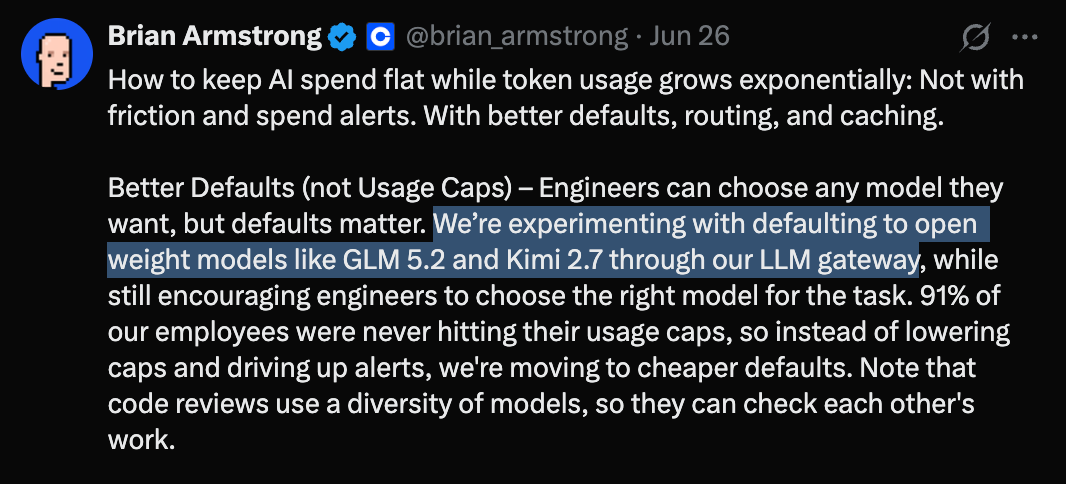
Companies will rely on a portfolio of models. Coinbase recently cut its AI spend nearly in half by switching engineers to Chinese open-source models like GLM and Kimi. Airbnb and Pinterest have done the same with Alibaba’s Qwen models. I believe that this will be the default path forward — using frontier for high-stakes work and cheaper models for everything else.
China’s open-source strategy is working. Chinese models are taking market share from frontier models at US companies. China is also building the full AI stack — from energy (e.g., solar, nuclear) to data centers to domestic chips. The Chinese government is planning a $295B investment in AI data centers with at least 80% of the chips built domestically.
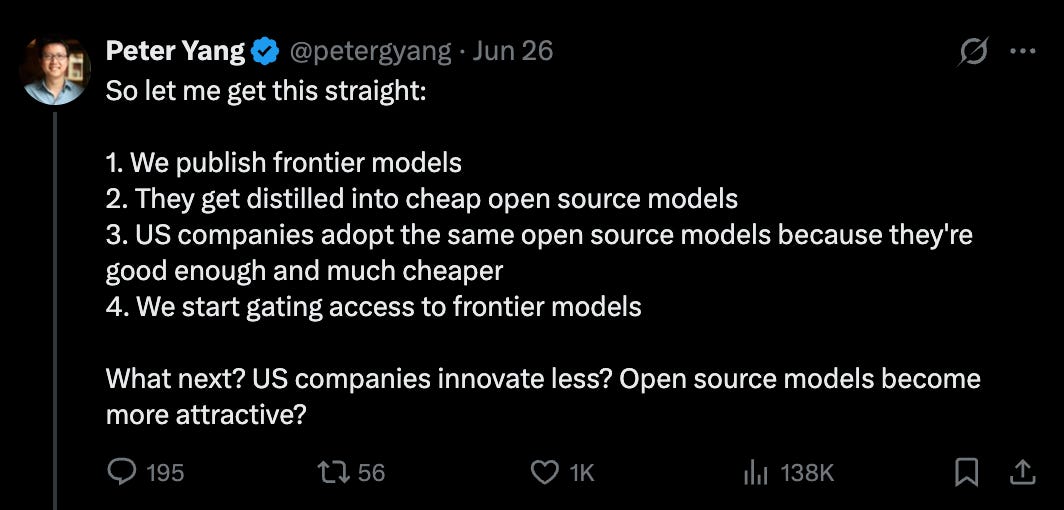
Frontier labs are in a catch-22 situation. If they release great open-source models, they might undercut their own frontier API revenue. If they gate the best models behind a trusted list, companies will just lean on open alternatives more. The last major US open-source model was OpenAI’s gpt-oss series back in August 2025, which already feels like decades ago in the AI space.
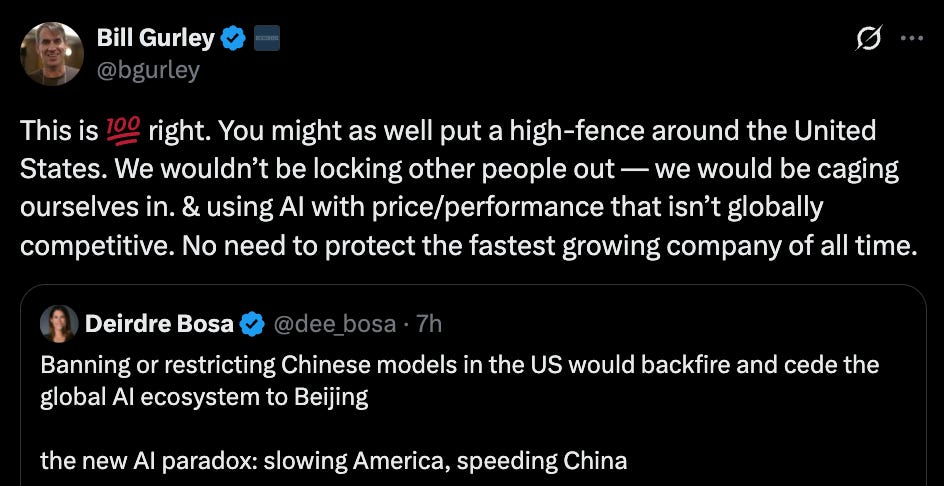
The US needs to think about its AI strategy holistically. I believe that restricting access to frontier models will only hurt American innovation. Banning US companies from Chinese models won’t work either. Just look at how China took over the global electric vehicle market. To compete, we need the best closed and open models while scaling our energy grid and data centers much faster.
The AI super app era is here
Anthropic and OpenAI want to transform all knowledge work. Both labs want to remake how white-collar work gets done with agents. What started with coding has expanded to design, finance, legal, science, and more. Knowledge workers are now adopting Codex three times faster than developers.
The race to build the best AI super app is on. Whoever wins it will take massive market share away from pre-AI knowledge work tools. The main players are Codex, Claude, Cursor, and a few others. With browser and computer use, I can already get Codex to handle almost everything I want to do on my computer.
OpenAI is well positioned to win the super app race. ChatGPT has 800M+ weekly active users and Codex is arguably the best AI super app right now. OpenAI has a clear opportunity to merge ChatGPT and Codex into one app and push agents into the mainstream. I think this is imminent.
Anthropic leads enterprise but has a fragmented product suite. Long term, I don’t think it makes sense for Claude, Cowork, Claude Code, and Claude Design to all exist as separate products. Working with Claude needs to feel more like working with a single capable coworker instead of a product suite. Claude Tag, Anthropic’s new agent for Slack, is a step in the right direction.

Software risks becoming a dumb pipe for agents
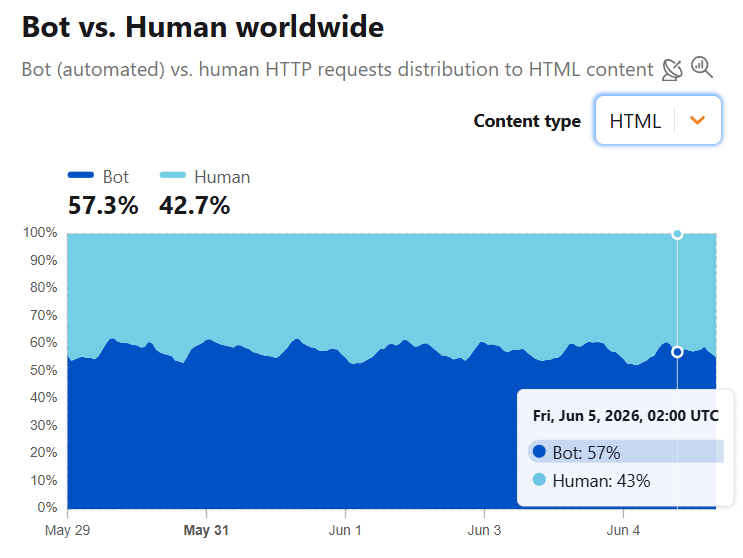
Agents are becoming the default user. Most products are still designed for humans clicking buttons, but agents will very soon read, write, buy, and do a lot more on our behalf. Cloudflare’s data shows that bot traffic to websites already exceeds human traffic. This matches my personal experience — I rely on agents like Hermes and Codex to browse websites and steer traditional apps.
If your product isn’t built for agents, it might as well not exist. Without clear APIs, documentation, and CLIs or MCPs, agents simply won’t discover your product, and neither will the humans who now lean on agents to find things. That’s why the best AI builders I’ve interviewed are all building for agents first.
Existing knowledge work products risk becoming dumb pipes. There’s a dark side to building everything for agents first. Take Google Workspace, for example. If I can just use Codex to edit Google Docs for me, I might never touch the Google Docs interface. Today’s apps risk becoming tomorrow’s dumb pipes for agents, the same way cable became the dumb pipe for internet apps.
Adding an AI chatbot to your product isn’t going to save you. A chatbot trapped inside a single app, with only that app’s context, can’t compete with an agent like Hermes or Codex that carries my personal context and gets work done across many apps. For example, I get a daily morning brief from Hermes that pulls info from my calendar, unread emails, and Slack.
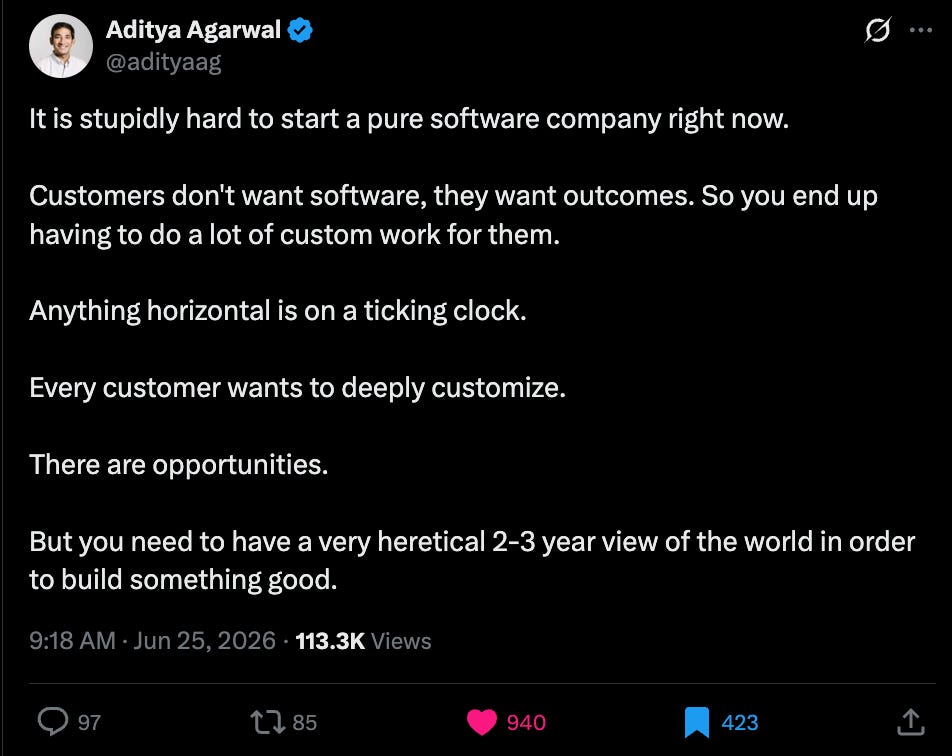
Pure-play SaaS is losing to services with SaaS bolted on. Companies don’t want another SaaS tool to onboard to and maintain. Instead, they want an outcome delivered to them. Pure-play SaaS will struggle to compete with AI skills that users and teams can build and personalize inside their favorite AI super app.
Cloud agents and collaboration are the next wave
Startups can compete with AI labs by going deep and using a portfolio of models. For example, coding startups like Devin and Factory are doing well because their harnesses route across multiple models to help customers save on cost without giving up performance. They’re also focused on a few specific use cases instead of trying to be everything to everyone.
Always-on cloud agents will be accessible from any device. Running agents with your laptop half-open will feel silly soon. Instead, many builders are already launching cloud agents using Cursor, Devin, and others. Codex and Claude Code are no doubt working on the same experience, and this will be the default soon.
Collaboration between agents and teams has yet to be figured out. The default agent harness with a list of threads on the left is still very much a single-player experience. The multiplayer experience is still being defined — whether that’s Claude Tag in Slack, agents in Linear, or something else.
“The future isn’t 20 terminal tabs. It’s better loops.” I watched Peter Steinberger share this in his keynote at yesterday’s AI Engineer conference. He no longer watches the agents code. Instead, he defines the requirements, and let agents plan, execute, and validate by themselves. I’m a bit wary of loops since they can lead to AI slop, but I’m sure better planning and models will make them more mainstream.
The AI market is about to get a lot more interesting
Here are my 18 takes summarized in four bullets:
The frontier-only AI stack is collapsing. Companies will use a portfolio of models to save costs, with everyday tasks defaulting to low-cost open models from China.
The AI super app era is here. Codex, Claude, Cursor, and others are competing to disrupt knowledge work by using agents for everything you can do on a computer.
Traditional software risks becoming a dumb pipe. Agents will become the default user. They’ll use APIs and browser use to access your website and app without humans ever seeing them.
Cloud agents and collaboration are the next wave. The future is agents living in the cloud, accessible from any device, and collaborating closely with both you and your team. This will happen very soon.
Let me know what you think about these takes in the comments!
Very interesting takes! Some of them resonate. I've been using (and now working with!) vybe.build for the agent-team-single-player collaboration and it's worked perfectly. I don't think a super app is the solution, and I feel like context bloat is already an issue with specialized agents.
One last thing: I am 100% sure agent chat alone isn't a solution: whatever happens in a chat (eg. a whatsapp conversation) gets lost at some point. Humans still need apps. The winner will have both an agent and apps, and agents can operate apps!
Great read, thank you