


Dear subscribers,
Today, I want to share a new episode with Sue Khim.
As the co-founder of Brilliant, Sue is building an AI tutor to help kids think for themselves. In our interview, she shared why better grades at school don’t always reflect learning and gave a demo of how AI can guide kids to understand problems instead of getting the answer. This episode is a must-watch if you’re a parent.
Watch now on YouTube, Apple, and Spotify.
Sue and I talked about:
(00:00) Why AI should make kids think harder
(01:34) Why test scores are down while grades are up
(09:41) Koji: An AI tutor that won’t give you the answer
(18:05) Why humans design lessons and AI builds them
(22:25) Primitives: The building blocks behind Brilliant’s AI
(29:30) Testing AI lessons with simulated students
(32:10) Measure learning, not lesson completion
(34:39) Sue’s rule for competing with the big AI labs
(39:10) How to raise kids who enjoy doing hard things
This episode is brought to you by… Linear

Linear is the tool of choice for over 40,000 AI-native teams ranging from startups to enterprises. Many of today’s leading AI companies, including OpenAI, Cursor, and Cognition, use Linear to run product development end-to-end with agents. Try it for free with my link below.
Top 10 takeaways I learned from this episode
How AI can help kids learn
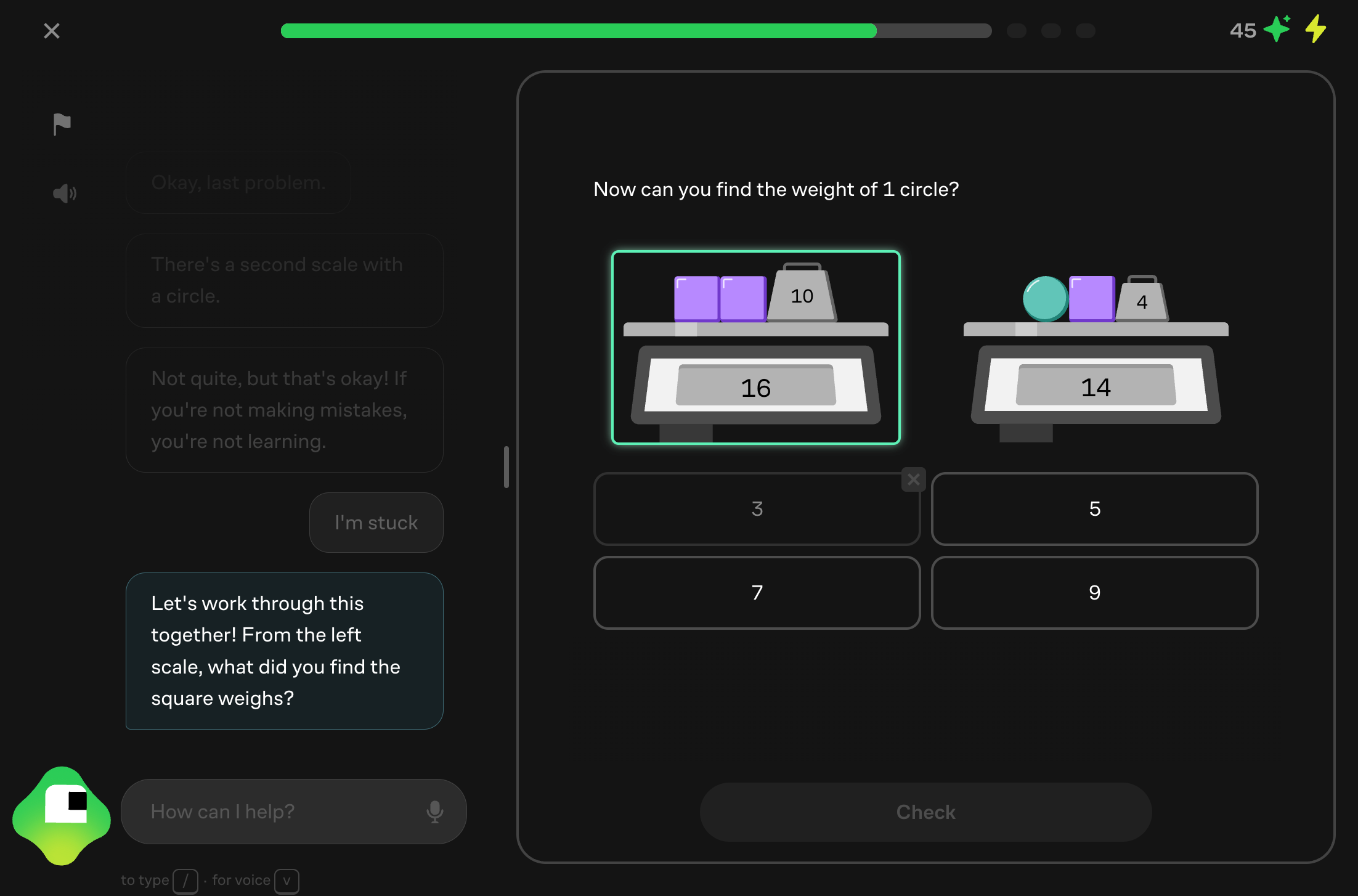
“Using AI to skip learning is like bringing a robotic arm to the gym to lift weights for you.” I told Sue I feel this temptation too: It’s easier to ask AI to solve a problem than to understand how to solve it myself. When teaching kids to use AI, teach them to ask it for questions and hints that help them work out the answer instead of just asking for the answer.
Even a good explanation can do the thinking for your child. From Sue: “Cheating and explanations are closer than you’d think.” Both can let a child skip working through a problem themselves. When your child gets stuck, ask them to explain their thinking before you explain the answer. Give them a chance to discover what they’re missing.
Help your kids get absorbed in their interests. Sue pays attention to how deeply her kids explore their interests. It could be monkey bars, chess, or magic tricks. The aim is to experience the effort and satisfaction of improving, without treating learning as something you do to please adults. “It should feel hard to learn something new.”