


Dear subscribers,
Today, I want to share a new episode with Ryan Wiggins.
Ryan is the VP of Product at Mercury, my favorite fintech product. We covered three things that are on every AI builder’s mind — how to make your product agent-ready, how to build a Claude Code second brain, and what Mercury’s data reveals about OpenAI and Anthropic’s race for the enterprise.
Watch now on YouTube, Apple, and Spotify.
Ryan and I talked about:
(00:00) Why APIs and MCPs are the primary interface
(04:40) How to get your product agent ready
(07:51) Will MCPs cannibalize your app DAU?
(10:36) How to decide between MCPs and CLIs
(13:10) Inside Ryan's Claude Code second brain
(18:40) Getting AI to coach you after every meeting
(20:46) Mercury data: Are startups switching to Anthropic?
(23:05) The product development process will never be the same
P.S. Mercury is offering Behind the Craft readers 1 year of free personal banking. Just click the link to get the discount.
I’m proud to partner with Wispr Flow

For many PMs and tech professionals, communication is the job. Slack replies, stakeholder updates, PRDs, emails — most of us are bottlenecked by typing speed.
Wispr Flow is the tool I use to close that gap. You speak naturally into any app and it outputs clean, ready-to-send text. It genuinely saves me 3 hours per week and works across Mac, Windows, iPhone, and Android. Use code PETERWISPRFLOW for 6 months free.
Top 10 takeaways I learned from this episode
How Ryan built his Claude Code second brain
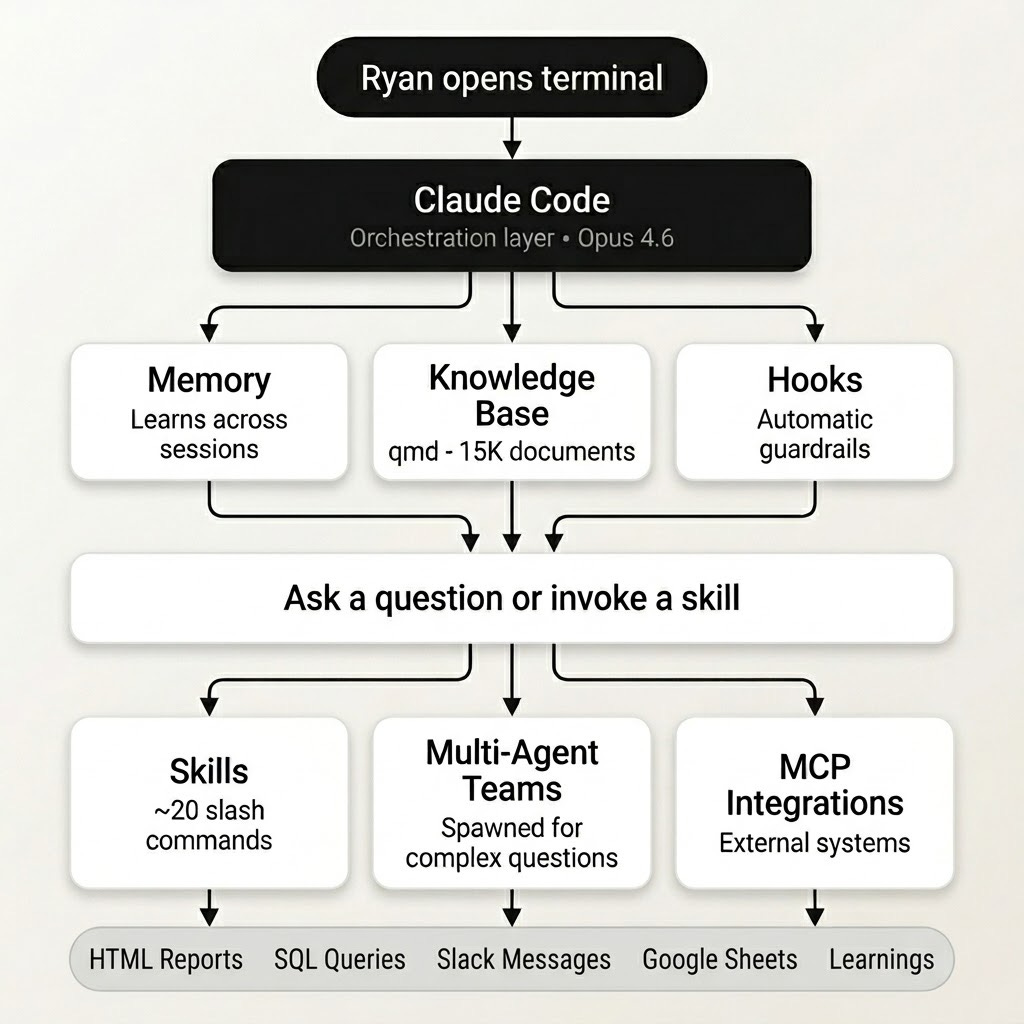
Ryan built a Claude Code “second brain” trained on 5 years of work history that helped him 2x his productivity as a product leader. He did this in 5 phases:
Create a profile. Have Claude interview you and write a me.md file capturing your role, goals, working style, and growth edges. This is the foundation.
Build the knowledge base. Save your most important docs — specs, retros, performance reviews — in a local folder. Then ask Claude Code to install QMD (Shopify CEO’s vector search tool) so it can reference these docs.
Distill the data. Ask Claude to create summary files using me.md and the knowledge base. For example:
strategic-context.md — what my company/team is trying to do and why
personal-growth.md — patterns in my feedback, coaching themes
Wire up auto-context injection. Create a Claude Code hook that pulls relevant context from the files above into every prompt.
Create the learning loop. Build a /learn skill that updates Claude.md after each session, plus cron jobs for morning briefs and monthly retros.
Ryan uses this to drive team priorities, make decisions, and self-reflect. It’s the most sophisticated personal OS I’ve seen, so I asked Ryan for a full 4,000+ word prompt that you can paste into Claude to set this up for yourself in 5 steps:
I want you to help me build a "Second Brain" — a persistent knowledge system that runs in parallel to my work using Claude Code. We'll do this in 5 phases. Walk me through each one interactively. Don't skip ahead — confirm each phase is working before moving on.

## Phase 1: Interview Me & Create my Profile

Interview me to create a file at ~/Documents/second-brain/me.md that captures:
- Who I am (role, company, responsibilities)
- What I'm optimizing for (goals, priorities, what success looks like)
- My working style (tools I use daily, how I communicate, what frustrates me)
- My growth edges (feedback I've gotten, patterns I want to break)
- What I care about outside work (interests, values — helps with recommendations)

Ask me 5-7 questions conversationally. Don't make me fill out a template. Write the file when you have enough.

## Phase 2: Build the Knowledge Base