



Dear subscribers,
Today, I want to share a new episode with Micky.
Micky is a full-stack engineer who has taught 100K+ people how to build with AI. In our episode, he walked me through his 4-step agentic engineering workflow to avoid pumping out slop: Isolate every task, build to a clear structure, prove via validation loops, and ship after agents review your PRs or escalate to you for a manual look.
Micky and I talked about:
(00:00) Why most software factories pump out slop
(02:06) Step 1 (Isolate): How to run multiple agents at once
(07:18) Step 2 (Build): Give agents a structure to build on
(10:44) Step 3 (Prove): Build agentic validation loops
(16:48) The one step Micky never hands to agents
(21:30) Step 4 (Ship): Getting agents to review PRs reliably
(28:20) Why Micky doesn’t write specs
(33:08) Comparing Astra and Fable for coding
(43:08) Are AI skills obsolete with today’s models?
I’m proud to partner with Wispr Flow
There are many AI voice dictation tools out there, but Wispr Flow has been the most reliable one I’ve used. My kids also love using it to build games and apps with Codex and Claude Code. Get a month free with my link below.
Top takeaways I learned from this episode
Micky’s 4-step agentic engineering workflow
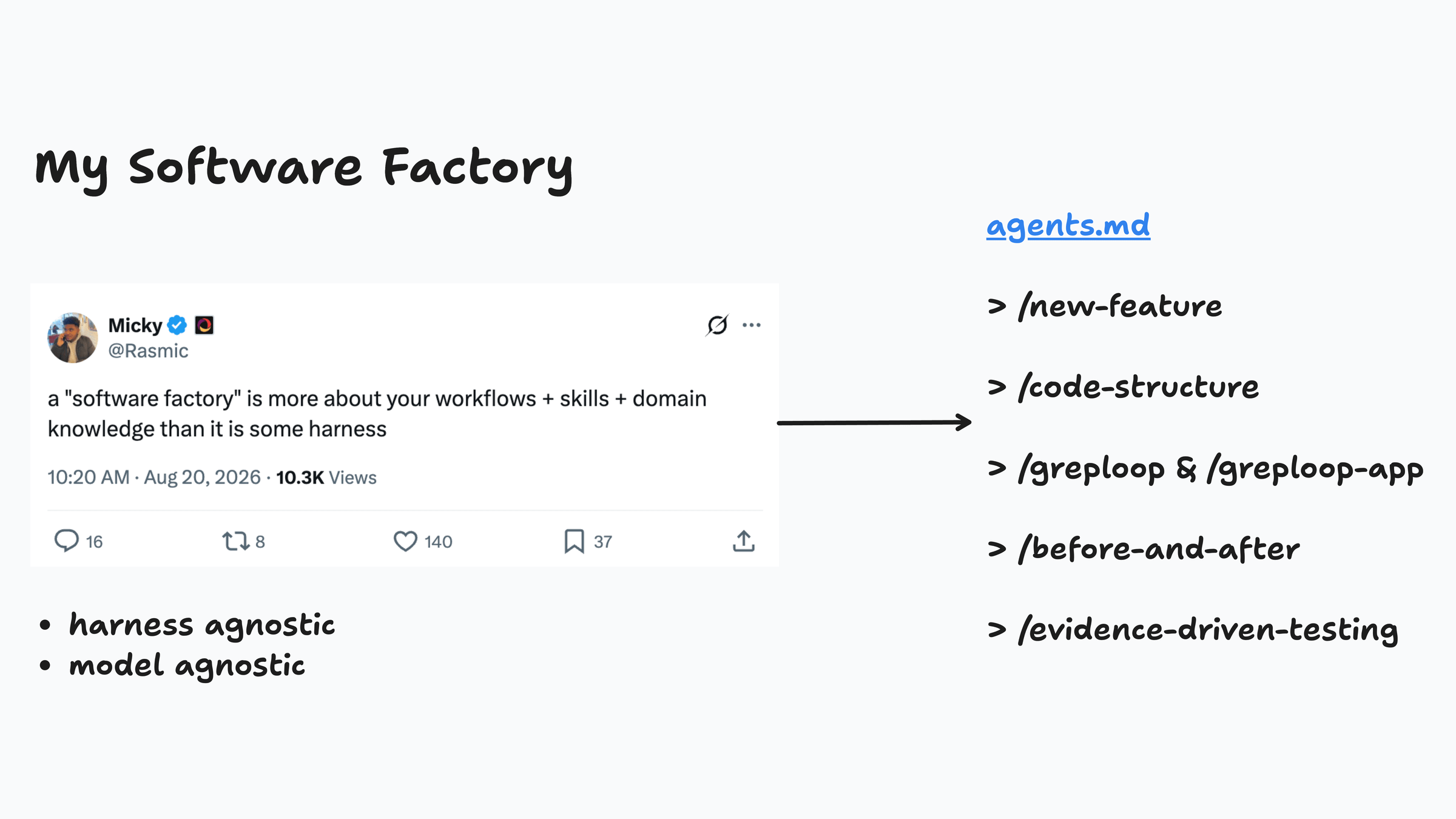
Use Micky’s 4-step workflow that makes agents prove their work before you merge. Micky’s “software factory” is his AGENTS.md file plus a handful of skills:
Isolate. The new-feature skill gives each agent its own copy of the code on a separate worktree, so that you can run multiple agents in parallel.
Build. The code-structure skill writes code based on service-layer architecture with explicit inputs and structured returns.
Prove. The evidence-driven-testing skill has the agent screen-record itself testing the app to compare the before and after states for a change.
Ship. The greploop skill uses Greptile, an AI reviewer, to test and improve the PR until it scores 5/5 with zero unresolved comments. Micky then usually reviews the PR himself before shipping.
Everything Micky ships to real users moves through these four steps.


