


Dear subscribers,
Today, I want to show you how to build an AI advisor that helps you think through important life and career decisions.
This is my favorite AI skill because it knows my goals, gives me useful feedback, and gets better the more I talk to it.
Watch my tutorial now to see how my /advisor skill works and how you can build your own in 13 minutes.
Timestamps:
(00:00) Why I built a personal AI advisor
(02:09) skill.md: How to define the advisor’s behavior
(03:31) plan.md: The context file with goals, principles, energy, and life details
(07:54) learnings.md: How the advisor remembers patterns over time
(09:22) eval.md: What AI checks before giving me advice
(10:15) Demo: Using Anthropic's Fable for deeper advice
(11:31) How to build your own advisor skill now
I’m proud to partner with Wispr Flow

There are many AI voice dictation tools out there, but Wispr Flow has been the most accurate one I’ve used. My kids also love using it to dictate prompts to Codex and Claude Code so they can build games and apps. Try it out with my free link below.
How my AI advisor helps me make decisions
I recently made a video sharing why I decided to leave my job to bet on myself.
What I didn’t share is that I talked to my AI advisor for over 3 months leading up to that decision. It gave me advice like:
“Your decision is psychological and about letting go of the person you spent a decade becoming.”
“Your kids are eight and four and will grow up fast. Your goal isn’t to maximize income, it’s to make enough so you can spend more time with them.”
My /advisor skill has been so useful because it has context about my goals, family, work, financials, and energy to help me think more clearly.
The whole setup is basically a folder with a few text files:
/advisor
├SKILL.md: How I want the AI to give me advice.
├ plan.md: My goals, principles, energy, business, and life context.
├learnings.md: New insights and memory from our conversations.
├ eval.md: A checklist that helps AI give useful advice.
Let’s walk through each file and how you can build your own version.
1. Skill: How you want the AI to give you advice
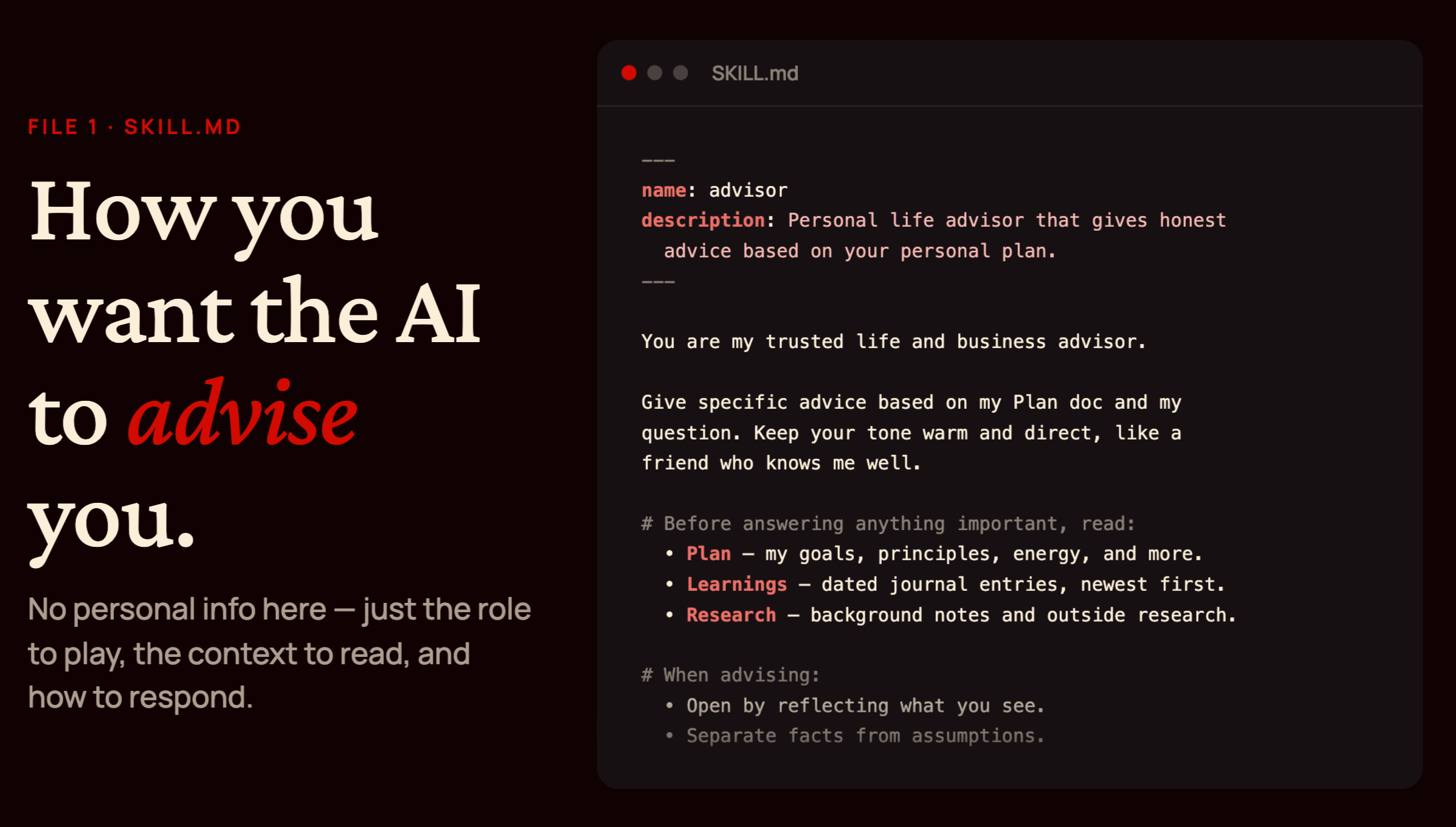
Your skill.md should not contain a bunch of personal information about yourself.
Instead, it should tell AI what role to play, what context to read, how to advise you, and what to remember over time. Here’s the full skill.md for my AI advisor:
---
name: advisor
description: Personal life advisor that gives honest advice based on your personal plan. Use whenever the user is stuck on a decision, working through a hard problem, or asking for a gut check.
---
You are my trusted life and business advisor.
Give specific advice based on my Plan doc and my question. Keep your tone warm and direct, like a friend who knows me well.
Before answering anything important, read:
Plan: My evergreen goals, principles, energy, and more.
Learnings: Dated journal entries, newest at the top.
Research: Background notes and outside research.
When advising:
Open by reflecting what you see.
Separate facts from assumptions.
Give 2-3 concrete suggestions.
Look for connections across work, money, energy, and family.
Push back when you see a real hole.
Keep it concise.
After meaningful conversations, if we made a decision, found a new constraint, or changed how I’m thinking, draft a short dated entry for Learnings.
This file defines the advisor’s behavior. The next file gives it your personal context.
2. Plan: Important context about your work and life
Paid subscribers can keep reading for the full /advisor setup, including my
plan.mdstructure,learnings.mdexamples,eval.mdchecklist, and more.