


Dear subscribers,
I’ve been thinking a lot about the future of product management.
When I talk to mid-career PMs, I hear the same frustrations over and over:
“I’m looking for a director role but all I see are IC jobs.”
“I want to work for an AI company but there are very few PM roles.”
“I’m too tired to build at night after a day of back to back meetings.”
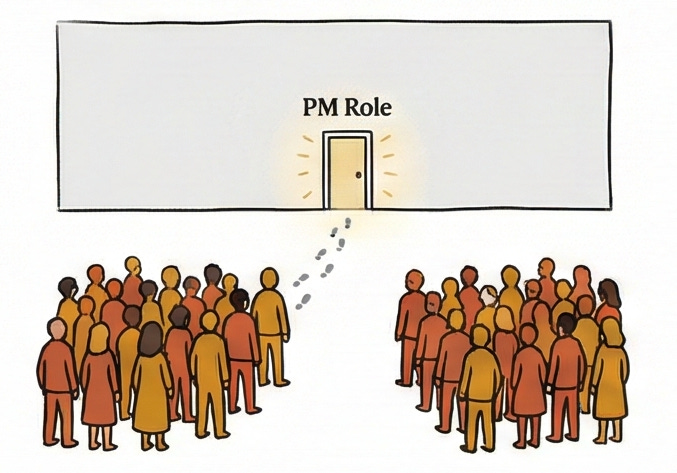
Meanwhile, AI-native companies like Anthropic and Cursor are hiring fewer PMs or delaying their first PM hire for as long as possible.
So what exactly is happening, and what can you do about it? Here are 8 hot takes on where I think the PM role is headed next and why I’m optimistic.
This post is brought to you by…HubSpot

HubSpot has put together a comprehensive guide to supercharge your productivity at work. This free resource includes:
Prompt database: 100+ ready-to-use prompts for immediate implementation
Industry-specific use cases: 15+ real-world applications across various sectors
Productivity best practices: 21 best practices to 10x your efficiency with AI
+ In-depth sections on emails, content creation, customer support, and data analysis.
1. There will be fewer great PM roles
I’ve interviewed 30+ founders and leaders at AI-native companies like OpenAI, Anthropic, Cursor, and Replit. They all believe the same thing:
Talent density > headcount.
Here are some direct quotes from leaders:
“You want a relatively small set of people where almost everyone you hire is really, really good." — Dario (Anthropic’s CEO)
“We have <30 PMs because we want to be the model of what it looks like to build a company on top of AI.” — Nate (OpenAI’s Head of Business Products)
Unfortunately, I think this means that there will be fewer PM roles at AI-native companies. It also means that your FAANG PM job is probably not as secure as you think it is. That’s because…
2. The old way of scaling teams is dead
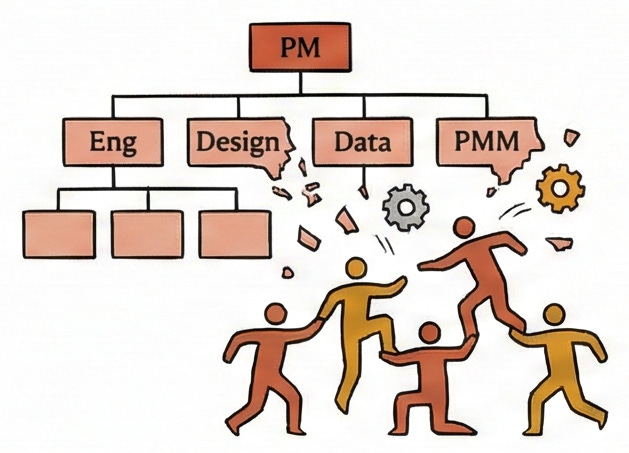
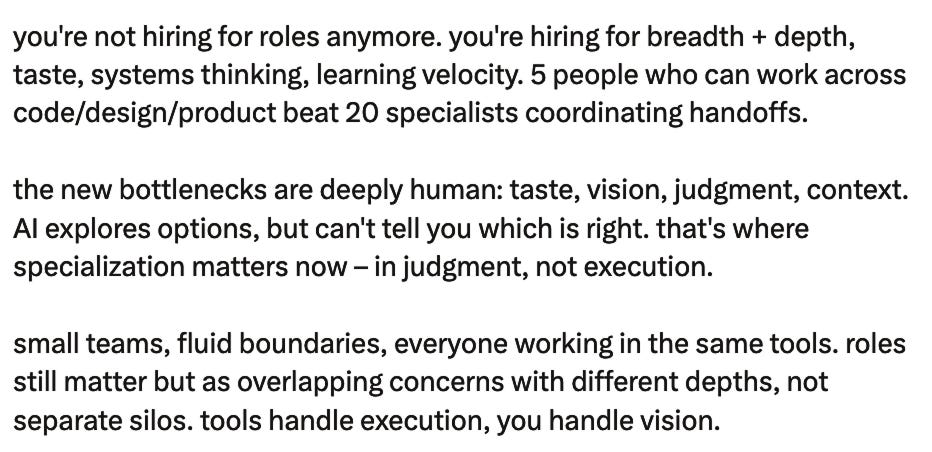
I worked at Meta during the ZIRP years where a typical product team had engineers supported by a PM, designer, data scientist, PMM, content strategist, and more. But the irony is that:
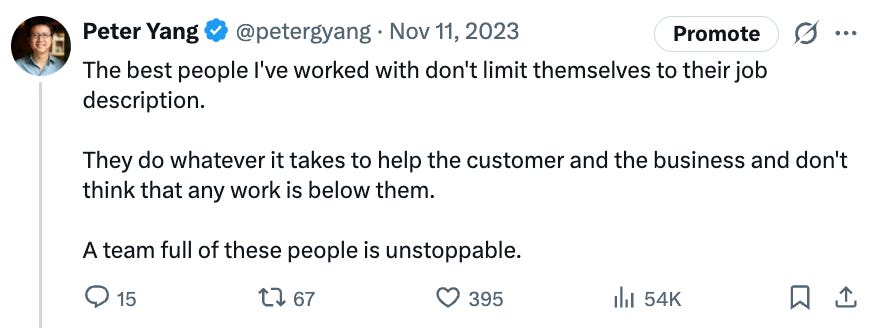
AI-native companies don’t want PMs who stick to their lane and think:
“I’ll let the PMMs market my product.”
“I’ll let the researchers talk to my customers.”
“I’m too busy with strategery™️ to dogfood.”
Instead, these companies want T-shaped builders — people with deep expertise in one area and enough breadth to contribute to many others. Ryo (Head of Design at Cursor) put it best:
My friend Ravi made this great point:
“Product management isn’t dead, but companies don’t have to hire PMs to do the job.”
Thanks to AI (just try writing a spec with Cursor), designers and engineers now have more bandwidth to cover PM tasks like summarizing customer insights and drafting product strategy. That’s why companies are delaying hiring PMs.
In the AI era, a PM who can’t build and an engineer who can’t define requirements will both struggle. If you’re still working at a company where you’re told to “stick to your lane,” then it’s probably time for a change.
3. Building will be a baseline expectation for PMs
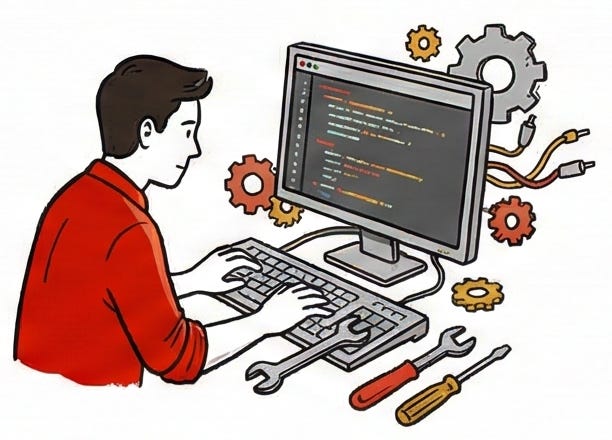
The more experienced I get as a PM, the less patience I have for PM theater like:
Spending more time documenting what you’ll ship than actually shipping.
Obsessing over internal docs instead of dogfooding the end user product.
Making decisions by committee and compromising the product along the way.
AI has collapsed the time from idea → prototype to hours.
Companies and teams that can build in the morning and get user feedback by lunch will win over those still doing waterfall development.
I don’t care if you’re a PM director with 10+ years of experience. You should still learn to spin up a prototype quickly, show it to real customers, and iterate.
This isn’t just my opinion. “Fast beats right” (Claire Vo) and “execution beats strategy” (Ami Vora) are direct quotes from product leaders whom I respect. Community-led development and building rapid feedback loops are what matter.
4. Taking AI courses and certificates is NOT building
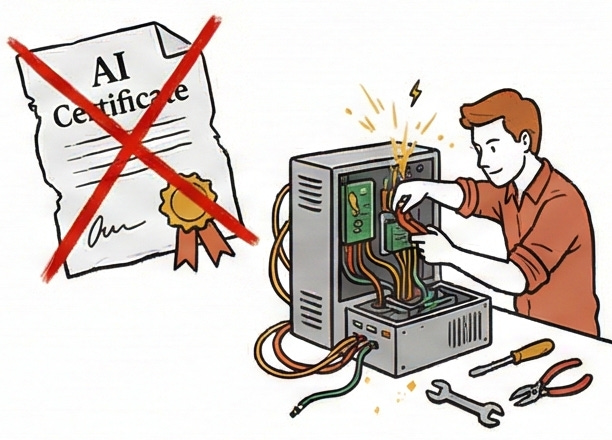
Hopefully, I’ve convinced you now that building is important. Now your first instinct might be to spend $1,000+ on an AI course to “learn to build.” Just keep this in mind:
If you don’t keep building after taking the course, then you’ve wasted your money and didn’t actually learn anything.
I cringe when I see people post: “I just got my AI PM certificate from XYZ course!” This is the equivalent of putting “AI PM” on your LinkedIn:
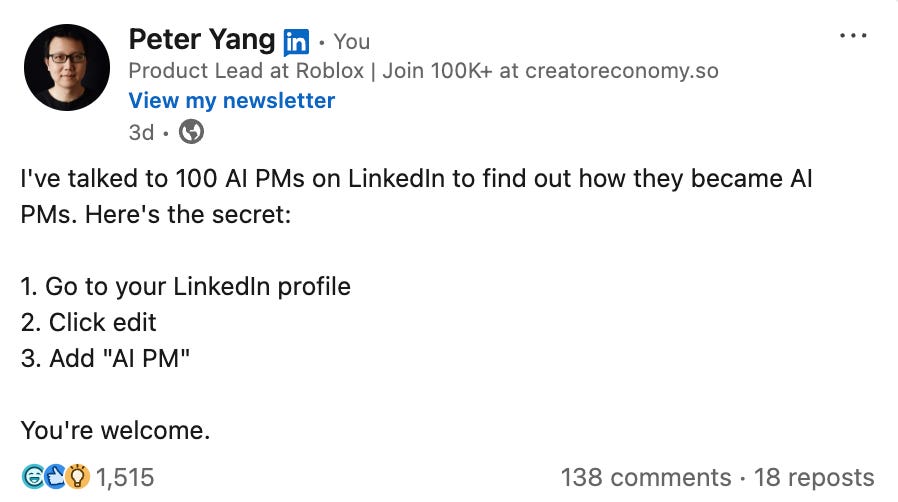
Nobody cares that you got an AI course certificate. What hiring managers want to see is proof of work:
“One of the most interesting interview signals is: What are you building in your spare time? People who like to tinker and build — they express themselves through prototypes, not docs.” — Josh Woodward (Gemini VP)
AI companies are explicit about this. Here’s a quote from Anthropic’s careers page:
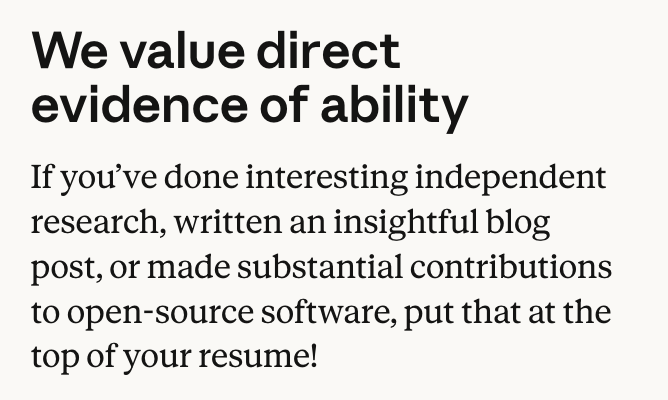
The only credential that matters to AI-native teams is what you’ve actually built and what tangible ideas you have to improve their product.
And the only way to learn this stuff is to get your hands dirty, make mistakes, and start shipping. Watch my AI tutorials if you need an extra push.
5. The higher you climb, the less time you have to build
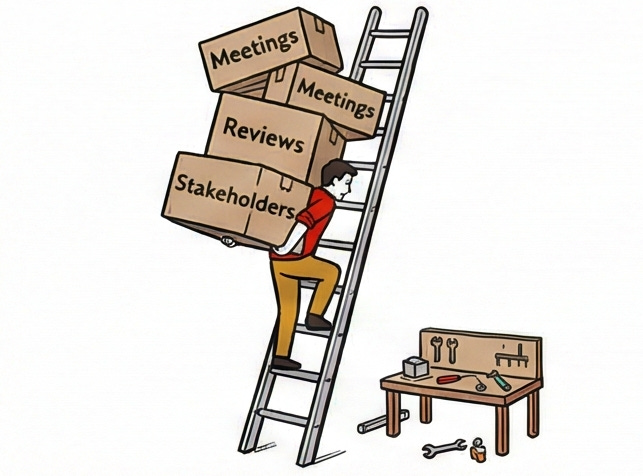
At this point, you may be thinking: “Look Peter, I’m just too tired after back-to-back meetings and putting my kids to bed to build.”
I hear you, I’m in the same boat. When I was young and naive, I thought “I really need to become a PM so I can finally build good products!” But here’s the irony:
PMs often have less time to build than other tech functions.
The higher you climb in the ladder, the less time you have.
Instead of building, you spend more time in reviews, stakeholder meetings, and performance calibrations. If you’re not careful, you can easily lose touch with the details and the craft of making the product.
So what’s the solution? For me, it’s being very intentional about protecting my time by:
Auditing recurring meetings. I ask: “Does this meeting still need to exist?”
Batching meetings. I try to cluster meetings so I have mornings for deep work.
Defaulting to async. I’ve become very good at async Slack threads.
This doesn’t always work and could backfire. But it’s a trade-off that I’ve consciously made so that I have more time to think, dogfood my product, and iterate with AI.
The funny thing is that I’ve had multiple CPOs email me after leaving their jobs asking how to vibe code. I also know several PM friends who have proactively moved from leadership roles at non-AI companies to IC roles at AI-native companies so that they can build again.

That’s because for the first time ever, ICs who use AI tools can have more leverage than people managers. Nikhyl (former Meta VP) has a great quote about this:
“Moving from a director role into an IC seat feels like a regression. But in today’s landscape, it’s often the only way to retool your skills and stay marketable. Think of it as a strategic setup: one step back now that lets you take two steps forward later.” — Nikhyl
Don’t let your single-minded pursuit of climbing the ladder take you away from crafting the product if that’s what you actually enjoy doing.
6. Be honest about your work and life constraints
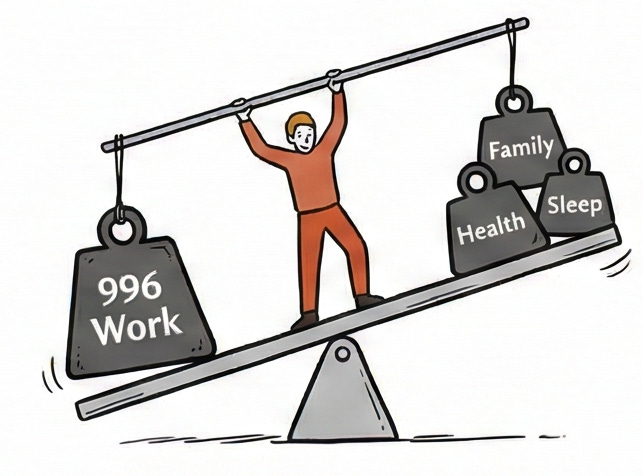
Here’s another uncomfortable truth:
Most AI-native startups operate at a pace that’s completely incompatible with being a parent.
Nikhyl has a great framework for thinking about different work intensities:
996 (9 am - 9 pm, 6 days a week): AI startups where you’re married to work. There are no boundaries—work is priority zero, everything else comes after. These startups are incompatible with parenting young kids, caregiving, or health issues.
Online after hours: The norm for most PM jobs at FAANG and growth companies. You’re on Slack at 9 pm but can establish some boundaries. Intensity comes in waves (e.g., launch periods, incidents).
No nights and weekends: Co-workers sign off at 6 pm and there are no weekend expectations. The trade-off is usually slower growth and less cutting-edge work, but you’ll have more time to build on your own.
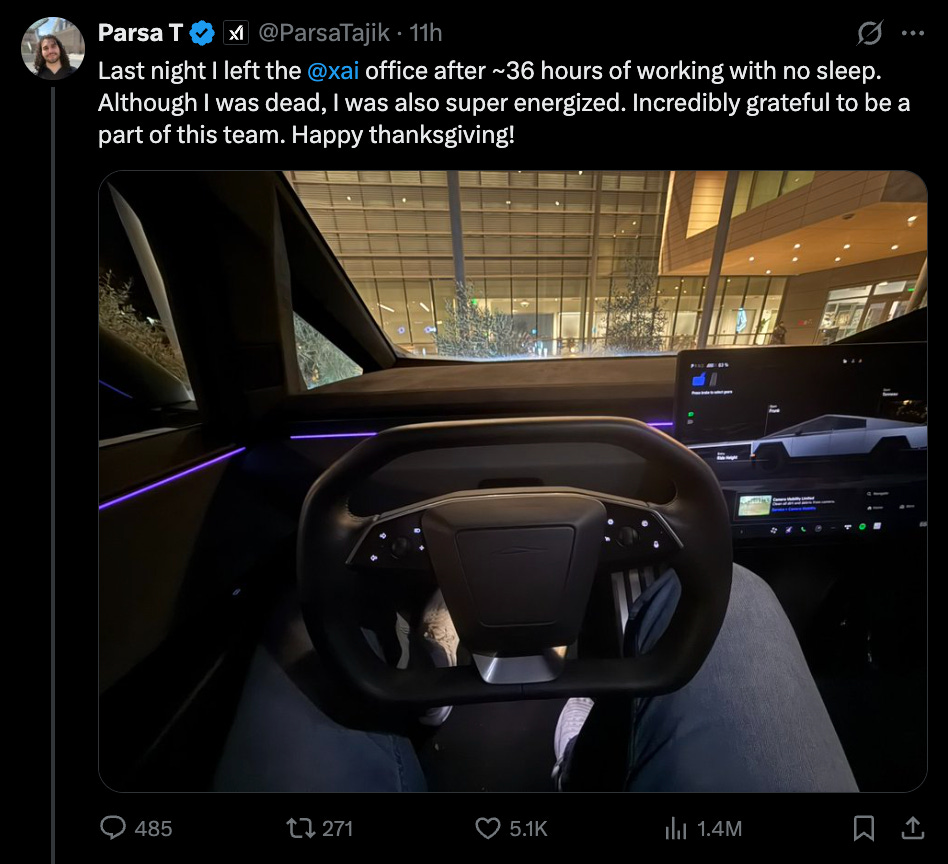
You have to be honest about your work and life constraints. I’ll never work at a 996 company because I want to watch my kids grow up. I do work nights and weekends sometimes because I care about shipping good products.
But those days are the exception, not the norm.
7. Aligning humans matters more than ever

I just wrote 6 points about how important it is to learn to build, but I also think that:
The human parts of the PM job will only become more important.
Aligning people is hard and remains valuable even on a small team.
AI can draft your launch plan, but it can’t walk into a meeting and resolve a deadlock between strong personalities. It can summarize user feedback, but it can’t read the room when a beta flops and you have to decide whether to delay.
The PMs who thrive will combine builder speed with influence — they can both show the future with a working app, and then bring the team along for the ride.
Think of building as a way to help you align with other people. A prototype gives people a much better sense of your product than any slide deck.
8. The most successful PMs will have that “just figure it out” energy
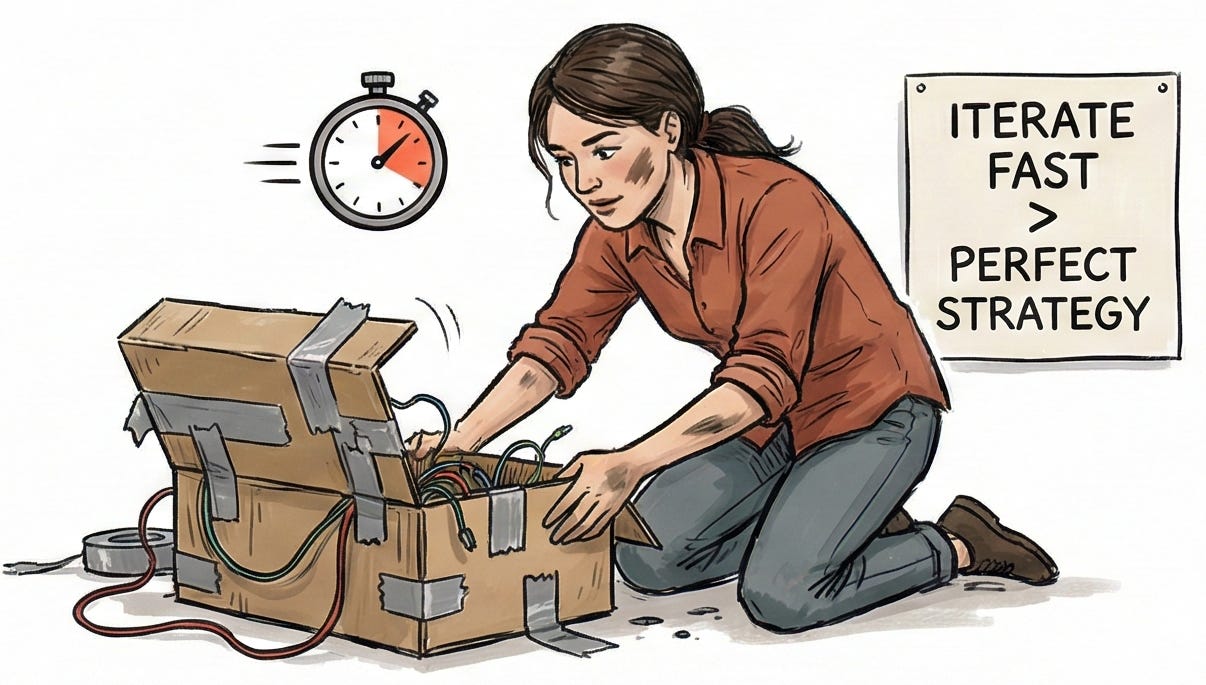
The PMs who thrive in this new world will have what I call “figure it out” energy — the willingness to wear multiple hats and solve problems instead of waiting for someone to teach you.
This shift is hard for big tech PMs because most of us have been trained to work within clearly defined roles and processes. We’ve learned not to “step on toes” so that stakeholders can give us good feedback during reviews. We collect FAANG credentials like infinity stones (I’m guilty of this). We’ve learned to check boxes and stack credentials our entire lives.
It’s time to wake up.
In an AI-native team, hesitation is more dangerous than stepping on toes, iteration speed matters more than perfect planning, and proof of work matters than credentials.
Being able to just figure it out is what matters.
What this means for your career
The bad news: There will likely be fewer great PM jobs.
The good news (and why I’m optimistic): The PM jobs that remain will be more fun — faster-moving, higher impact, and closer to crafting the product.
As PMs, it’s up to all of us to evolve our role toward what we actually love doing. I’ll leave you with three tangible next steps:
Learn to build something yourself. Start by watching my beginner tutorials to build a Chrome extension in Cursor, beautiful websites using Replit, and AI headshot and movie discovery apps with Claude Code. But don’t just watch the tutorials — build them yourself!
Tighten your feedback loops. Tell your team that you’re no longer doing waterfall development. Shorten the time from idea → shipped change → real-world learning to one day cycles. Reject doing more than 3 rounds of internal iteration without talking to a single customer. Practice community-led product development.
Be honest about your constraints. Working 996 for an AI native company comes with real sacrifices. Look for companies where you can do good work and sprint for short periods but still have time to be with your family.
The PM profession is at an inflection point. The skills that got many of us here won’t take us where we need to go.
But if you build the right skills and bring that “just figure it out” energy, you could soon be doing the most fulfilling and impactful product work of your career.
I don't think it's only PM jobs that are heading in this direction where proof of building is more valuable than anything else. I see it elsewhere in other jobs, e.g. marketing, business analyst. Job titles don't mean anything now as the market seems to have combined previously separate roles into one. We are in the age of the builder now that we have consumer technology that lowers a huge bar for everyone to go from 0 to prototype. All of us, regardless of job titles and expertise, got to get our hands dirty by building with AI and showing proof of that in public.
Fantastic article. AI is not replacing strong PMs, but it is ruthlessly eliminating average ones. Product work sits squarely in the first impact zone, yet many professionals outside tech still seem completely unaware of how soon the same shift is coming for them.